

Investing in a quality grinder is essential to getting the most out of your beans at home. The grinder is the link between a good bean and a good cup: if it fails, not even the best coffee in the world can save the result.
Many enthusiasts discover that the grinder is, in many cases, more influential than the brewing machine itself, since it defines the foundation of the drink and how predictable the extraction is. Grinding right before brewing is essential to preserve the aromatic oils and volatile compounds, which start oxidizing and dissipating minutes after grinding.
1. The Grinder as the Heart of Extraction
Investing in a quality grinder is essential to getting the most out of your beans at home. The grinder is the link between a good bean and a good cup: if it fails, not even the best coffee in the world can save the result.
Many enthusiasts discover that the grinder is, in many cases, more influential than the brewing machine itself, since it defines the foundation of the drink and how predictable the extraction is. Grinding right before brewing is essential to preserve the aromatic oils and volatile compounds, which start oxidizing and dissipating minutes after grinding.
2. Grind Variables and Flavor: Scott Rao's Science
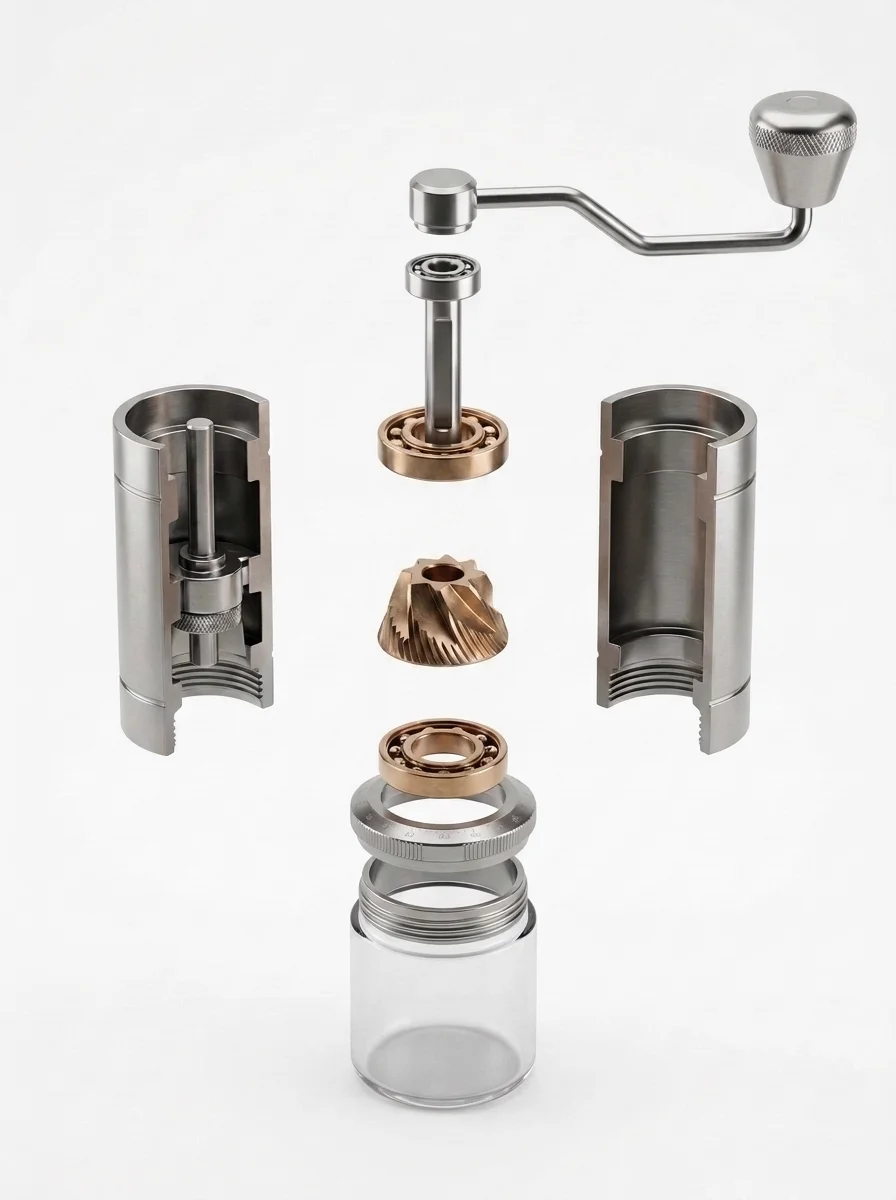
According to Scott Rao, there's no universal "magic" setting; the ideal grind depends on multiple variables, which is why he avoids recommending "setting X for grinder Y."
- Dose and bed depth: deeper coffee beds (larger doses) offer more resistance to flow and require coarser grinds than smaller doses.
- Fines production: the percentage of ultra-fine particles (fines) drastically affects brew time, because fines have a disproportionate effect on how fast water moves through the bed. Fines production increases with darker roasts, with certain origins (Ethiopians in particular), with decaf, and — a point often overlooked — with bean temperature: colder beans generate more fines (part of the rationale behind freezing coffee or using RDT).
- Calibrate by time, not by micron: this is Rao's central point. Saying "grind at 650 µm" is risky advice, because the peak of the particle-size distribution ignores the percentage of fines, and fines are what govern flow. The real target of calibration is the ideal total extraction time for that dose and method, not a number on a dial.
- The golden rule of calibration: when adjusting the grinder, always start coarser than you expect to need. Too fine chokes and channels, leaving the coffee astringent and unpleasant; too coarse just comes out a bit weaker or more acidic, but stays drinkable. On top of that, the shorter time of a first coarse attempt gives you a better read on how much to fine-tune next; once a too-fine grind stalls the extraction, it's much harder to judge the adjustment.
Grind consistency is the secret to getting the most out of your specialty coffee. But remembering the exact click setting for yesterday's espresso and today's French press off the top of your head is a challenge that frustrates plenty of coffee lovers. To eliminate wasted beans and guarantee a repeatable, perfect cup, Coffee Codex offers a complete management and calibration system for your equipment — turning the app into the brain of your grinding station.
3. Evaluation Criteria: Rao and Lance Hedrick
To evaluate a grinder beyond the marketing copy, it's worth combining two perspectives: Rao's objective criterion and Hedrick's sensory/engineering criterion.
- Extraction level (Rao): this is the most overlooked and the most objective criterion. Manufacturers publish burr diameter, kg/h, and RPM, but almost never talk about extraction. For Rao, between two grinders under the same parameters, the one that produces higher extraction almost always delivers the tastier coffee — and lets you use less coffee for the same strength. His practical example: swapping a grinder that yields ~19% extraction for one that yields ~22% lets you pull shots at the same TDS using fewer grams per dose; at café scale, that turns into hundreds of kilos saved per year. As burrs wear down, extraction drops; improving alignment raises it.
- Sensory profile (Hedrick): the choice should consider whether you prefer clarity (distinct notes, vibrant acidity) or body/mouthfeel (creamy texture, blended sweetness).
- Alignment (and a counterintuitive point): having the burr mounted on a stable, well-aligned shaft ensures more consistent particle distribution. But heed Rao's warning: alignment can outweigh burr quality. A poorly aligned top-tier grinder can still extract higher, yet taste worse; a well-aligned mid-range grinder can beat it. Alignment matters just as much as the burr's numbers.
- Adjustment granularity: for espresso, look at how many microns the burr moves per click. The 1Zpresso J-Ultra, for example, offers 8 microns per click, the finest adjustment in the 1Zpresso lineup. But remember the previous point: fine adjustment is for hitting the target precisely; the target is still a result measured in time and taste, not a micron number in itself.
4. Technical Anatomy: Blades, Burrs, and Materials
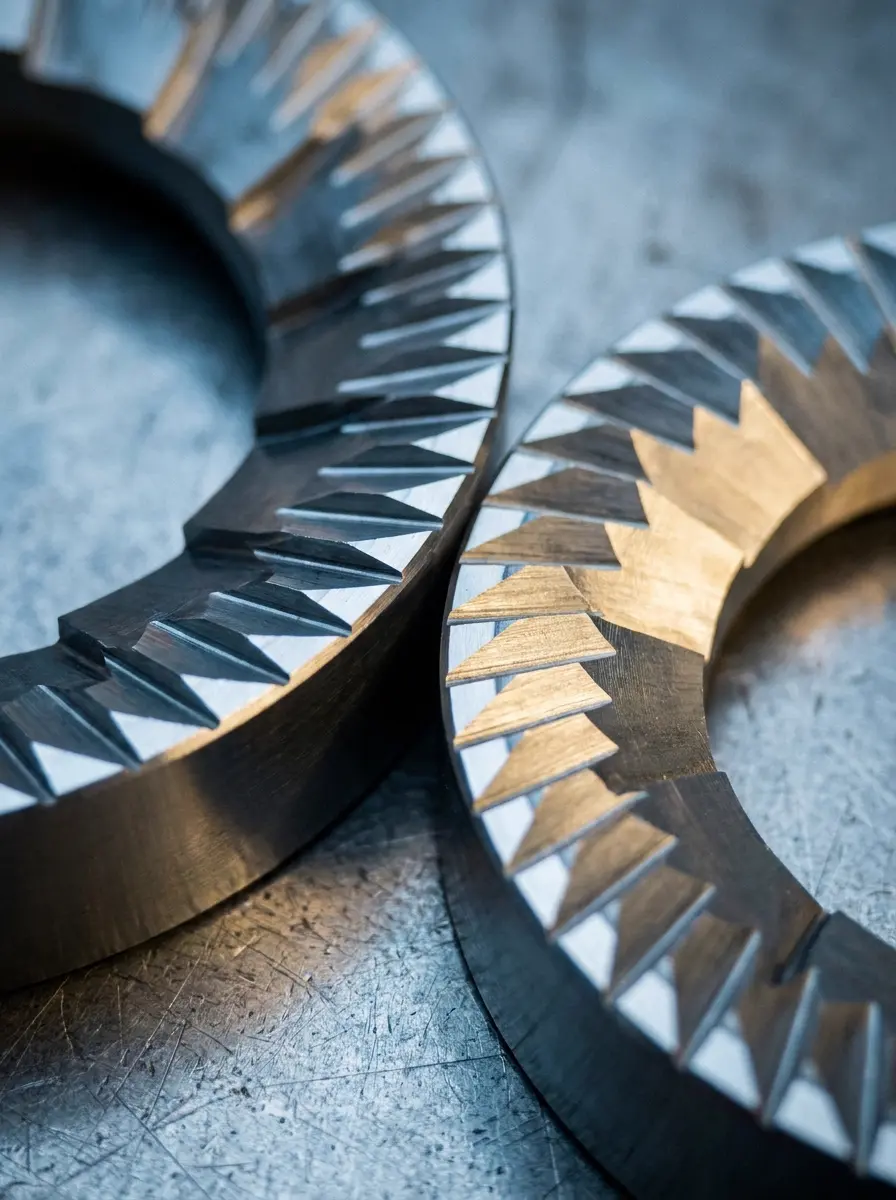
The choice of internal mechanism defines the grounds' uniformity and the quality of the drink.
- Avoid blade grinders: blade grinders work like blenders, producing irregular particles and heating the beans, which hurts flavor.
- Burr grinders: these are the standard of excellence, using two pieces that crush the beans evenly and in a controlled way.
Steel vs. Ceramic
- Stainless steel: the standard for most home and commercial grinders. It's tough, handles heavy use, and rarely chips if something hard enters the mechanism. It also tends to be cheaper. On the downside, it dulls faster (may need resharpening or replacement over time) and transfers more heat during grinding, which can slightly affect flavor, especially in fine espresso grinds.
- Ceramic: holds its edge far longer (the cutting edge lasts longer), transfers less heat (preserving delicate compounds), and resists corrosion in humid environments. The downsides are fragility (it can crack or chip if a small stone gets into the grinder) and a higher upfront cost.
On fines, sources disagree. Guides like The Way to Coffee claim ceramic burrs tend to produce more fines. Meanwhile, burr manufacturers like LeBrew describe ceramic as precise and well-suited to fine grinds, without linking it to more fines. According to LeBrew, most ceramic burrs on the market are found in entry-level grinders (Porlex Mini, Hario Skerton), which makes it hard to separate the effect of the material from the effect of cheap geometry and alignment. In practice: the question isn't settled — weigh both views when deciding.
Conical vs. Flat (a tendency, not a law)
As a generalization, conical burrs tend to highlight body and sweetness, while flat burrs tend to offer greater uniformity and clarity. But treat this as a tendency, not a rule: "ghost burr" designs and the big modern flats show that the specific design and alignment matter more than the category, and, in the end, Rao's objective criterion (measuring extraction) matters more than the "conical" or "flat" label.
5. Manual vs. Electric: What's Your Ritual?
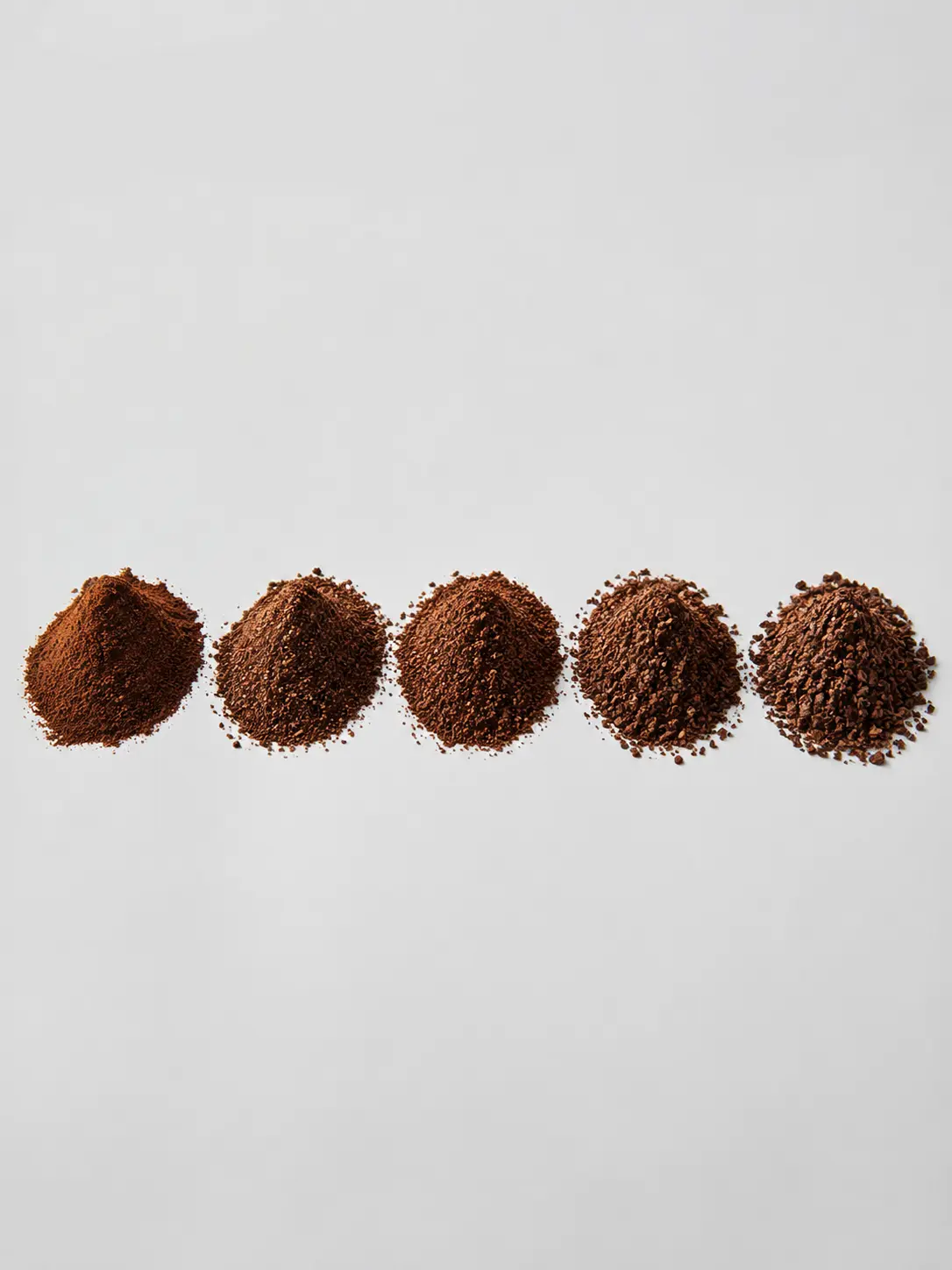
The choice depends on your routine and the volume of coffee you brew.
- Manual: the best value, portable, quiet, and generating little heat. In exchange, they demand physical effort, especially for espresso, where a fine grind is slower and more tiring (a larger burr helps speed it up).
- Electric: convenience and speed, ideal for anyone brewing large quantities daily. Entry-level filter-focused models include the Baratza Encore (for espresso, the dedicated version is the Encore ESP); at the advanced end, options like the Tramontina by Breville line handle espresso and filter with precision.
- A technical note on RPM (Rao): many modern electric grinders let you adjust RPM, which complicates "setting number" recommendations. Increasing RPM behaves, for most of its effect, like tightening the setting finer — meaning "setting 5" at 400 RPM can behave like "setting 6" at 1500 RPM. If you change the RPM, recalibrate.
6. Buying Guide by Consumption Profile
The recommendations below separate what comes from Lance Hedrick's tier list from additions based on other reference tests.
From Hedrick's list
- All-rounder: the Lido OG (the only S-tier on his list) and the 1Zpresso K-Ultra shine at both espresso and filter. The K-Ultra stands out for its numbered external ring, which lets you switch methods in seconds, with very low retention.
- Espresso focus: the Kinu M47 is a workhorse for dense extractions, with stepless precision adjustment (the manufacturer states steps as fine as ~5 microns) and excellent alignment by design.
- Filter focus: the 1Zpresso ZP6 targets light-roast enthusiasts chasing analytical clarity.
- Best value: the Kingrinder K6 delivers external adjustment at ~16 µm per click and is surprisingly capable at espresso for the price.
Additions (other references)
- Comandante C40: a benchmark burr geometry for clarity and consistency, more filter-oriented; to fine-tune espresso, the optional Red Clix axis reduces the step from ~30 µm to ~15 µm per click.
- 1Zpresso J-Ultra: espresso-focused, with the already-mentioned 8 µm-per-click adjustment: fine control for chasing the exact shot.
- Timemore C2/C3: a great-value entry point, with steel burrs and consistent results in the mid range (filter). For espresso, the adjustment steps are too coarse to fine-tune precisely (the main limit at this price range).
- 1Zpresso X-Ultra / X-Pro: a versatile middle ground between the C2 and the K-Ultra. External adjustment at ~20 µm per click, solid build, and great value for filter. A smart choice for anyone wanting a quality manual grinder without jumping straight to the top of the line.
- Timemore Chestnut S3: an evolution of the C2 with SAP burrs (larger cutting surface) and external adjustment. A direct competitor to the K-Ultra at a more accessible price. Impressive grind consistency for the price range.
- Pietro (Fiorenzato): co-developed by Lance Hedrick, with 60mm flat burrs. Exceptional filter clarity, comparable to much pricier electric grinders. Requires the optional base for ideal ergonomics, but delivers one of the best particle distributions for filter on the manual market.
Recommended Electric Grinders
If the convenience of an electric grinder speaks louder, these options cover everything from entry level to top of the line:
- DF54 / DF64: the most talked-about electric grinders of recent years. Interchangeable 54 mm (DF54) or 64 mm (DF64) flat burrs (SSP, Italmill, Mazzer), aluminum build, quiet motor, and single-dose operation. The DF64 in particular lets you swap the burr set for different extraction profiles — rare at this price point. The DF54 is the entry version (~$200) that delivers 80% of the performance for half the price.
- Fellow Ode Gen 2: the gold standard for home filter brewing. 64 mm SSGP flat burrs, award-winning design, single-dose with very low retention. If all you do is filter and you value aesthetics and repeatability, it's one of the best purchases you can make.
- Baratza Encore ESP: the updated version of the classic Encore, with finer adjustments for espresso. A benchmark for durability and customer support.
Comparison Table: Which Grinder Should You Buy?
To help with the decision, here are the main models organized by price range, burr type, and ideal use profile.
| Grinder | Range | Burrs | Best For | Highlight |
|---|---|---|---|---|
| Timemore C2 | Entry ($) | 38 mm conical steel | Beginner filter | Absolute best value |
| 1Zpresso X-Pro | Mid ($$) | 48 mm conical steel | Versatile filter | External adjustment, light |
| Kingrinder K6 | Mid ($$) | 48 mm conical steel | Best-value all-rounder | 16 µm/click, drill-ready |
| Timemore S3 | Mid ($$$) | Conical steel SAP | Mid-range all-rounder | SAP burrs, build quality |
| 1Zpresso K-Ultra | Mid ($$$) | 48 mm conical steel | Top all-rounder | External ring, low retention |
| 1Zpresso J-Ultra | Mid ($$$) | 48 mm conical steel | Espresso | 8 µm/click |
| Comandante C40 | Premium ($$$) | Conical Nitro steel | Filter clarity | Geometry benchmark |
| Kinu M47 | Premium ($$$) | 47 mm conical steel | Espresso precision | Stepless ~5 µm |
| Pietro (Fiorenzato) | Premium ($$$) | 60 mm flat steel | Filter analysis | Exceptional clarity |
| 1Zpresso ZP6 | Premium ($$$) | 48 mm conical steel | Analytical filter | Light roasts |
| Lido OG | Premium ($$$) | Conical steel | S-tier all-rounder | Lance's only S-tier |
| DF64 | Mid ($$$) | 64 mm flat steel | Versatile electric | Interchangeable burrs |
| Fellow Ode Gen 2 | Premium ($$$) | 64 mm flat SSGP | Electric filter | Design, single-dose |
| Baratza Encore ESP | Mid ($$) | Conical steel | Entry electric | Versatile, great support |
7. Maintenance and Longevity
For your investment to last for years without losing coffee quality, maintenance is essential.
- Regular cleaning: coffee oil residue oxidizes and leaves a rancid flavor. Use a dry brush weekly and do a deeper cleaning every two weeks (more often if you grind dark roasts, which are oilier).
- Watch out for the metal parts: avoid using water directly on steel burrs or internal metal parts, to prevent corrosion. A soft brush handles it.
- Bean storage: avoid leaving beans in an electric grinder's hopper for long periods, since light and heat from the motor speed up the coffee's aging.
8. Conclusion: Control Over Flavor
Owning a good grinder isn't just about crushing beans: it's about having control over flavor. Whether in the quiet ritual of a manual grinder or the precision of an electric one, it's the tool that lets you truly explore the sensory notes of specialty coffees. And, more than any marketing spec, what separates a good grinder from a great one is what it does for extraction — measured in time, in the cup, and, when possible, on the refractometer.
9. How Coffee Codex Puts It All into Practice
The theory of calibration and choosing the right grinder are the starting point. The next step is making sure all that knowledge translates into repeatability at your bench every day — and that's where Coffee Codex comes in as a tool.
9.1 Build Your Equipment Arsenal
You no longer need scattered notes on your phone to remember when you bought your equipment or what material the burrs are made of. In Coffee Codex, you register your entire collection.
From your digital bench, just add a new grinder by choosing the brand and model from our pre-loaded list of the market's leading names. Beyond the model, you can log its service history, including purchase date, price, condition, and personal notes.
9.2 Click and Grind-Size Calibration
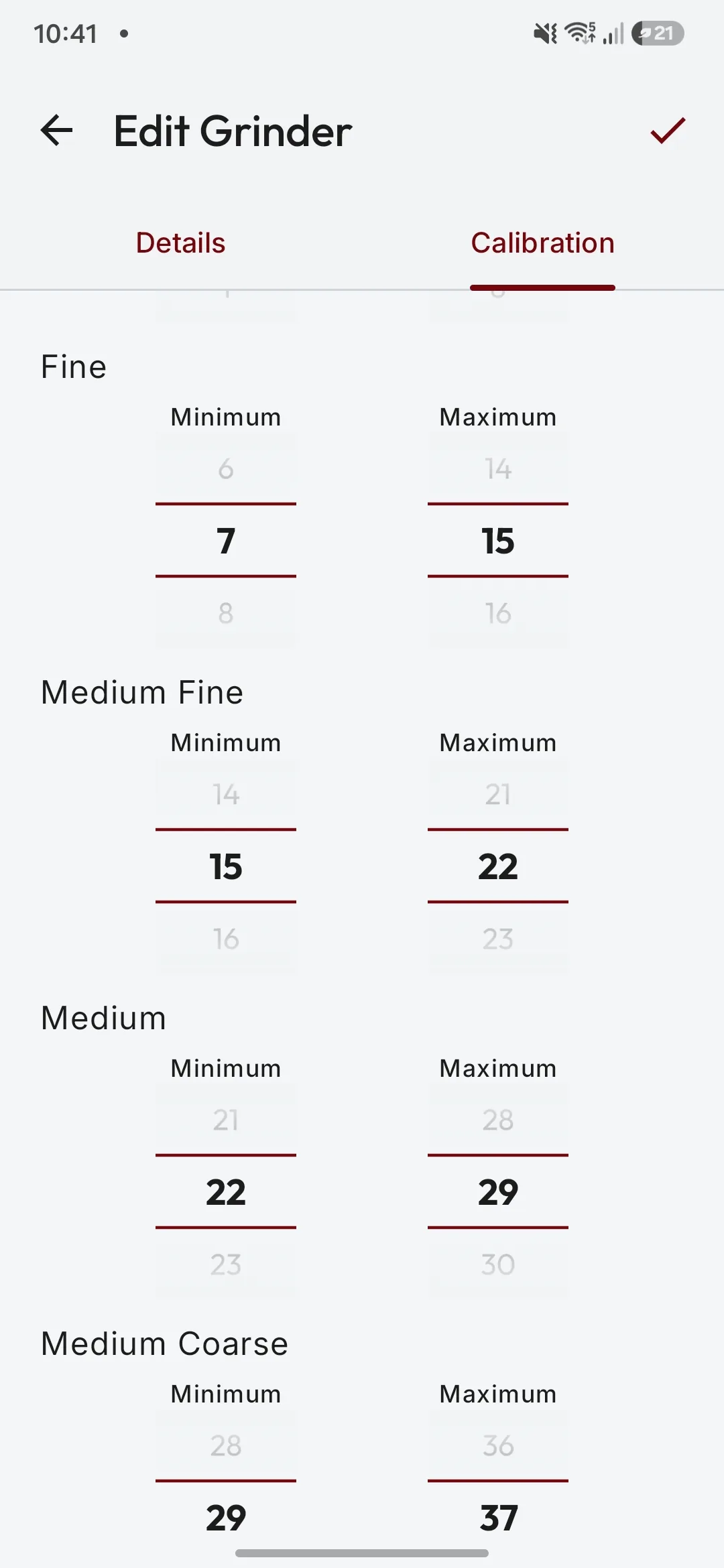
Different brewing methods require different particle sizes. Coffee Codex lets you calibrate each grinder in your setup across 7 precise grind levels: Extra-fine, Fine, Medium-fine, Medium, Medium-coarse, Coarse, and Extra-coarse.
- Automatic presets: to streamline your routine, models well established in the community (like the Comandante C40, 1Zpresso JX-Pro, Baratza Encore, and Niche Zero) already come with their calibration ranges pre-filled in our database.
- Custom adjustment: got a different grinder, or want to fine-tune it yourself? You can manually set the range (e.g., "Medium: 20 to 28 clicks"). The system is smart: the moment you edit a value, automatic calibration is disabled for that range, strictly respecting your preference.
9.3 Grind Size Built into Your Recipes
The real magic happens when it's time to brew. When you create a recipe in Coffee Codex, just select which equipment you're using and the grind level you want.
The app cross-references your setup's data and instantly shows the exact values for that extraction on screen (e.g., "24 clicks / ~720 µm"), translating the visual grind size into your equipment's physical setting.
9.4 A Default Grinder for More Speed
You know that trusty grinder you use every morning? You can pin it as your default equipment. That way, every time you start a new Brew Log, it's already selected, saving you time. The app will also use that specific equipment's calibration to show grind-size tips in the recipes you save.
9.5 Freedom to Edit Your History
Your setup evolves, and the app keeps up. At any point, you can refine an equipment's calibration. And if you sell or swap grinders, deleting one is simple and safe: removing a grinder from your inventory doesn't affect the history of your past Brew Logs. Your past recipes stay intact, showing exactly the equipment you used at the time.
Turn your grinder into a precision machine
Download Coffee Codex, register your equipment, calibrate your clicks, and integrate grind size into your recipes. Free on Google Play.
Get Coffee Codex10. Sources and References
Reference sources: Scott Rao ("How to Choose a Grind Setting" and "Using Extraction Levels to Rate Grinders"), Lance Hedrick's manual coffee grinder tier list (and the related discussion thread on Home-Barista), SCA ("Designing Flavor: Why the Grinder Is Becoming Coffee's Most Critical Brewing Tool" and "How to Choose the Right Bulk Coffee Grinder"), LeBrew ("Understanding the Difference Between Ceramic and Steel Burr"), The Way to Coffee ("A Coffee-Lover's Guide to the Best Manual Coffee Grinders"), and 1Zpresso (J-Ultra specifications).